
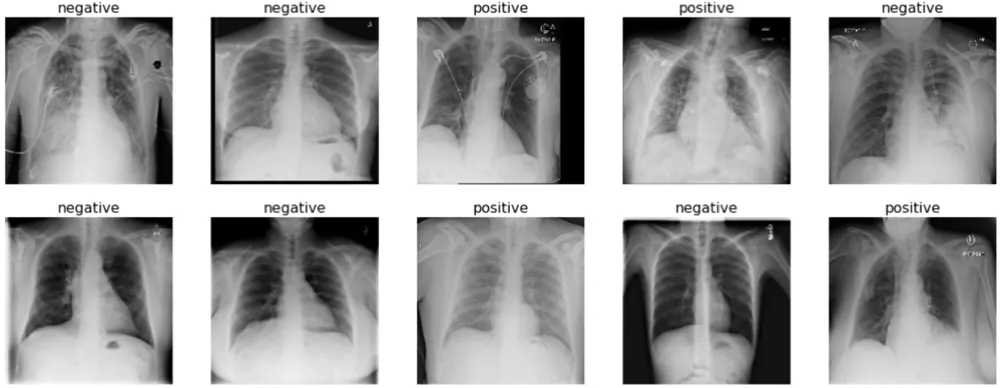
01WhatCan a model see it in the lungs?
Our group chose a project related to the pandemic: detecting COVID-19 in patients, framed as classification. This page covers my part, the chest X-ray images. The data is COVIDx CXR-2 from Kaggle: 16,490 positive and 13,992 negative training images, a balanced test set of 200 + 200, each 200 × 200 pixels.
02HowThree models, one question.
- KNN (K = 2) as the baseline, on scaled images and without augmentation, since shifted images would distort the distances.
- Our own CNN — two convolution layers (kernel 5), two max-pooling layers, two dense layers, ReLU and a sigmoid output, with dropout, batch normalization and augmentation.
- VGG16 transfer learning — a pre-trained VGG16 plus two dense layers.
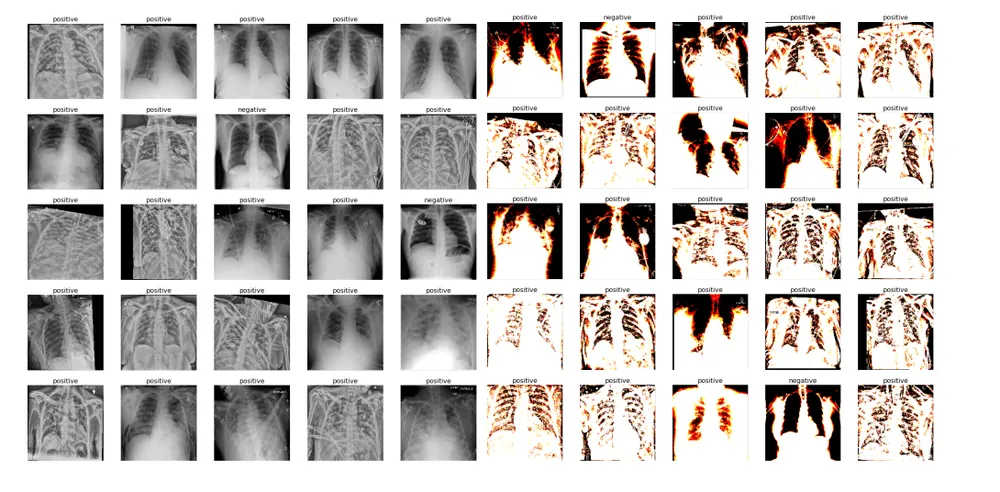
03ResultsTransfer learning wins twice.
- 0.69
- KNN baseline, test accuracy
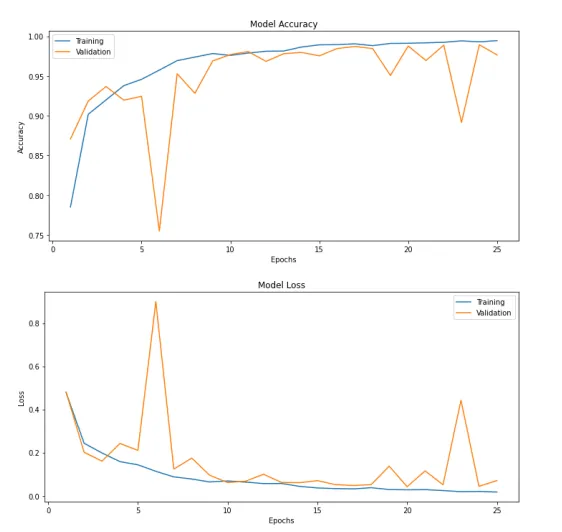
- 95.25%
- own CNN, test — 3.6 h of training
- 97.25%
- VGG16, test — 1.8 h of training
Transfer learning was both more accurate and twice as fast to train. One caveat: a downsampling mistake left the training data unbalanced, so all three numbers have room to improve.
04ThoughtsShadows.
Even by eye, positive X-rays often show a “shadow” in the lungs, which is why letting a model learn from the images seemed promising — and 97.25% suggests it is feasible. If it really is about spotting shadows, an object detector like YOLOv5 could be the next thing to try.
Adapted from my original write-up · more in the links above.